




A business annual report is a routine state compliance filing, not a financial report or tax return. Most LLCs and corporations must file one with their state, typically once a year, to keep their public record current and maintain good standing. Still, requirements vary by state and entity type.
- If you own an LLC, corporation, or nonprofit: You may need to file an annual report with the state where your business is registered.
- If you run a tax-exempt nonprofit: You may need to file IRS Form 990 or Form 990-PF with the federal government, plus any state annual report filing.
- Note: An investor or shareholder annual report is a separate document not covered here.

What is a business annual report?
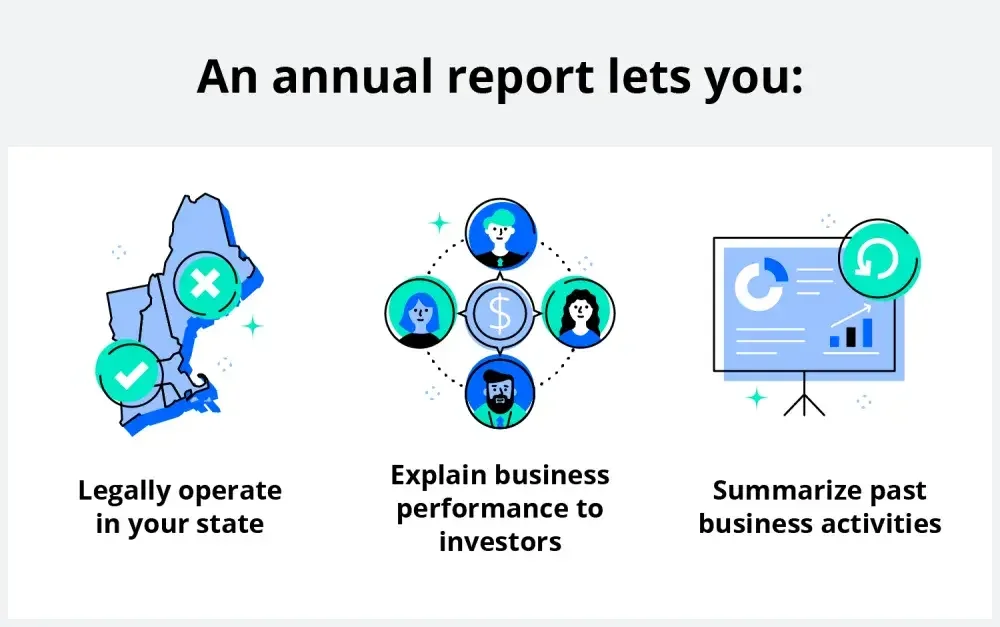
An annual report is a state-required compliance filing that keeps your company's public record current and helps maintain good standing. Good standing is the general term that is often used to describe the status a business holds when it has met all state filing and fee obligations, and losing it can block you from signing contracts, securing financing, or operating in the state.
Most people assume annual reports are only for publicly traded companies, but this isn’t the case. This filing is not a financial disclosure or a shareholder report. Some states bundle franchise tax payments with the annual report, but those are separate obligations. Paying franchise tax does not replace the annual report.
The annual report typically confirms or updates:
- Legal business name and principal address
- Business purpose
- Names and addresses of owners, members, or officers
- Registered agent's name and address
Who has to file an annual report?
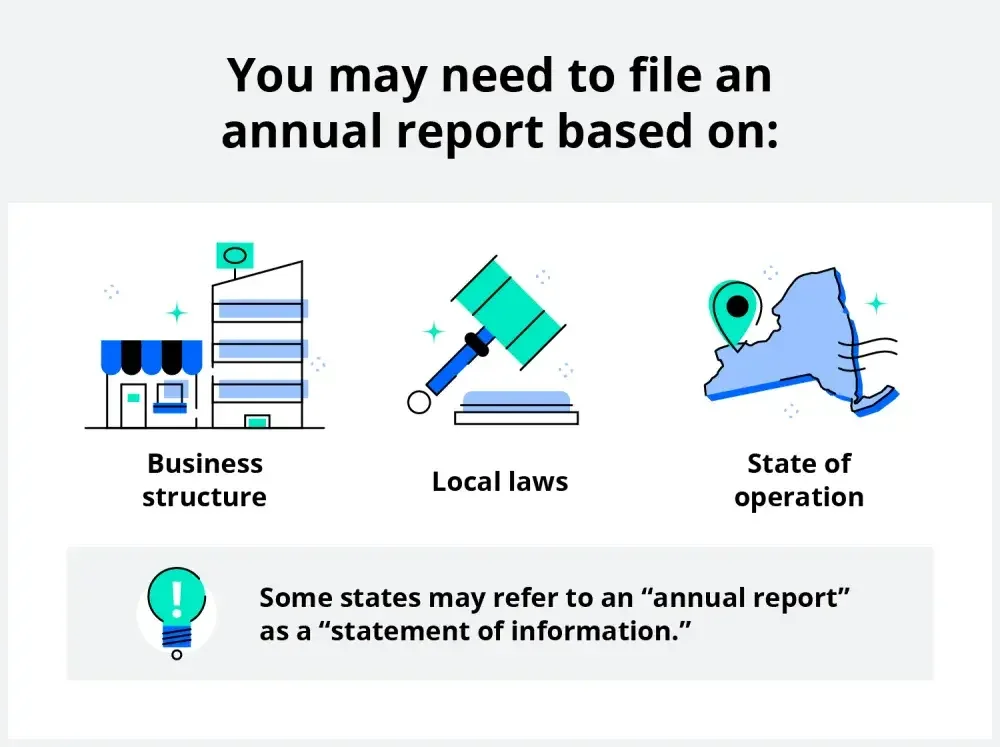
Statutory business entities (corporations, nonprofit corporations, LLCs, limited partnerships, and limited liability partnerships) generally must file an annual report with the filing office in their formation state and every foreign state where they do business. Confirm your specific obligation with your state's official filing agency first.
Note on terminology: Not every state uses the term "annual report." The same obligation may be called an annual registration, periodic report, biennial statement, or statement of information. Some states also impose an annual LLC tax with no separate report, as Delaware does. Some states do not require one to be filed.
LLCs
Most states require LLCs to file annual reports. A handful of states, including Arizona and Missouri, currently exempt LLCs. A few use biennial intervals.
Any LLC registered in a state must file, even if nothing has changed. For a full walkthrough, see how to file an annual report for your LLC.
Corporations (C corps and S corps)
Annual report requirements apply to both domestic and foreign corporations in nearly every state. The federal C corp and S corp tax election does not change the state compliance requirement. The obligation typically begins the year after formation or foreign qualification and continues until the entity formally dissolves or withdraws.
Foreign-qualified entities
Registering in additional states means filing in each one. For instance, a Delaware LLC with foreign qualifications in California, Texas, and New York must track filing requirements in all four states, each with its own deadlines, fees, and filing portals. Filing inactivity or zero revenue creates no exemption.
Nonprofits (state-level obligations)
Some states require nonprofits to file annual reports with the Secretary of State or similar filing agency. Others require a separate charitable solicitation registration renewal with the Attorney General's office.
State requirements are entirely separate from federal Form 990 filings. A nonprofit may owe both a state annual report and a federal information return in the same year.
What to gather before you file your annual report
Before getting started, double-check that you have everything on hand. You’ll generally need to provide the following information, depending on the state.
- Legal entity name: Use the exact name registered with your state, including abbreviations like LLC or Inc. A trade name or DBA will not match and will cause a rejection.
- State file number or entity number: This appears on your business formation documents or in your state's free business search portal.
- Formation or registration state: The state where the entity was originally formed, not necessarily where you currently operate.
- Principal office address: The primary physical location. Most states do not accept a P.O. box.
- Mailing address: Include only if it differs from the principal office address.
- Registered agent name and address: Must be current. If you've moved or changed agents since your last filing, update it now.
- Names and addresses of officers and directors (corporations) or managers and members (LLCs): Include only those your state requires. Verify against your current operating agreement or corporate records.
- Business purpose: A short description of what the business does. Some states require this; others don't.
- NAICS code: Required in states like Connecticut. Look it up at census.gov/naics.
- Email address: Used by the state to send your filing confirmation.
- Payment method: Most portals accept credit or debit cards. A small number still accept checks for mail-in filings.
How to file an annual report
Most states now prefer or require online filing. Online submissions can generate a confirmation within minutes; mail filings can take days.
- Confirm your state's filing requirement and cadence. Verify that your entity type must file. Some states exempt certain entities or treat domestic and foreign entities differently. Confirm whether your state requires an annual, biennial, or periodic report. Due dates follow one of three patterns: a fixed calendar date for all filers, your entity's anniversary month, or your formation month. Assuming the wrong basis is a common source of missed deadlines.
- Look up your business in the official state business database. Search the state's public business entity database by legal name or entity number. Confirm your entity's status (active, delinquent, or otherwise), verify you're filing for the correct entity, and check your next filing due date.
- Open the official state filing portal. Go directly to the Secretary of State or equivalent agency's online filing system. Do not use paid search ads. Those links frequently lead to third-party services charging unnecessary fees. Bookmark the portal for future filings.
- Review any prefilled entity information. Many portals prepopulate fields from your last filing. Verify every field. Outdated information in a prepopulated field gets submitted as current if you don't catch it.
- Update required fields. Enter or confirm your principal address, registered agent, and officers/directors (corporations) or managers/members (LLCs). If your state requires a business purpose or NAICS code, update those, too.
- Pay the filing fee. Fees vary by state and entity type. Always verify the current fee on your state's official portal. Save your payment confirmation separately from your filing confirmation.
- Submit and save your confirmation. Download or print the filing confirmation immediately. Save a PDF of the completed report itself, not just the receipt. Check your email for a separate state-issued confirmation notice.
Set a reminder for your next filing deadline. Add your next due date to your calendar before closing the portal. Set a secondary reminder 60 to 90 days before the deadline.
What happens if you miss the annual report deadline?
Missing a deadline is not a minor administrative slip, and consequences can escalate quickly.
Consequences of a late or missed filing
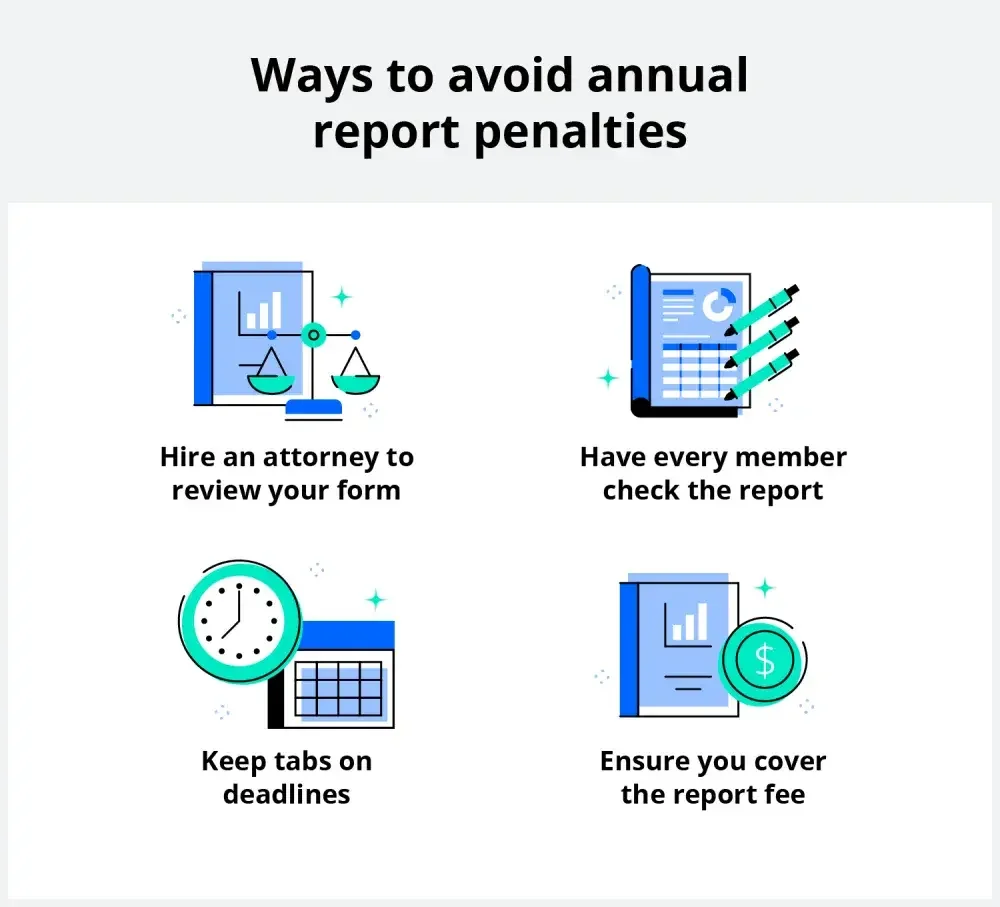
Most states impose fees immediately after the deadline. These range from $25 to several hundred dollars, and some states use progressive penalty structures that double or triple for entities that stay delinquent.
Verify your state's current penalty schedule on the official Secretary of State website.
Loss of good standing
State records may list your entity as not in good standing, inactive, or delinquent. Federal, state, and local agencies commonly require certificates of good standing for bid submissions and contract awards.
You also need good standing to file for a foreign qualification in new states.
Administrative dissolution or revocation
If reports remain unfiled long enough, the Secretary of State may administratively dissolve your entity, formally terminating its legal existence. Most states issue a Notice of Delinquency or Notice of Intent to Dissolve first, typically providing 60 to 90 days to correct the issue.
If a lapse occurs in a foreign state rather than your home state, the result is administrative cancellation or revocation.
Once dissolved, your company loses its legal authority to conduct business. It may wind up exiting operations (settling debts, liquidating assets) but cannot start new operations. Your company name becomes available to others, and directors or officers may face personal liability for actions taken during the dissolution period.
How to fix a missed filing
The path depends on your entity's current status. A delinquent entity follows a simpler process than one already dissolved or revoked. Check your status first.
- Check your entity's current status in the official state business database. A delinquent status means the entity missed its report but hasn't been dissolved. Washington, for example, gives domestic entities 120 days from the notice date to correct. If the record shows administrative dissolution or revocation, the process is more involved.
- Identify all overdue filings. Some states require submission of each missing report and fee. Others only require the most recent. Illinois caps this at six years of back reports when filing for reinstatement. Check your state's specific rules.
- File the overdue reports and pay all past-due fees and penalties. Pay everything owed at once if possible. Partial payments typically do not restore good standing.
- If dissolved or revoked, complete a formal reinstatement filing. This requires a dedicated application (often called Articles of Reinstatement or Certificate of Revival) plus all back fees and penalties. For foreign entities whose authority was revoked, some states require a fresh application for a certificate of authority rather than standard reinstatement. LegalZoom offers a business reinstatement service to help manage this process.
- Confirm restoration to good standing. Return to the state's business database and verify active or good standing status. You may then order a Certificate of Good Standing. Do not assume reinstatement was accepted just because the payment processed.
Some states limit how long reinstatement remains available after dissolution, typically between two and five years.
Beyond the reinstatement window, re-forming as a new entity may be the only option, requiring a new legal entity, new tax IDs, and potentially losing rights to the previous company's name and assets.
If your entity was dissolved or revoked in multiple states, or you're unsure of your standing, consult a business attorney or compliance specialist before attempting reinstatement. LegalZoom's reinstatement concierge service can manage the process end to end.
DIY vs. filing service vs. professional help
Three paths exist. The right one depends on your entity's status, how many states you file in, and how much time you want to spend.
- DIY makes sense when you're in good standing, filing in one state, have no ownership disputes, and just need to confirm or update basic entity information.
- A compliance filing service is practical when you want someone to track deadlines, prepare the filing, and submit it on your behalf. LegalZoom's annual report filing service handles preparation and submission for you.
- An attorney or a concierge service like the ones at LegalZoom makes sense when you're late in multiple states, your entity was dissolved or revoked, you're handling a merger or ownership change, or you run a nonprofit with both state and federal obligations.
FAQs about annual reports
How often are annual reports due?
Contrary to their name, not all states require annual reports once a year. Some states require that you turn in a report yearly, while others have a biennial timeline.
The report may be due on the anniversary of your business' formation, or your state may have a single due date for everyone. Other states require you to send an initial report within a specific period after your business' formation. Research your state's guidelines for your business type to learn how often you must provide a report so you do so on time.
How much does it cost to file an annual report?
The cost to file your annual report will depend on which state you're filing in and what type of business entity you have. An LLC may pay a different fee than a corporation. The filing fee in some states is free, while other states may charge a filing fee for annual reports that’s $300 to $500. The fee from state to state can vary significantly.
In addition to the fee to file your annual report, some states also charge a franchise tax. This may be a flat fee or might be based on your company’s revenue or assets.
Can I file my LLC annual report online?
In some states, yes. In other states, you’ll be required to submit your business filings through the mail.
Do all states require an LLC to file an annual report?
No, whether or not you are required to file an annual report depends upon the state. States such as Arizona, New Mexico, and Ohio do not require LLCs to file annual reports.
Is a business annual report the same as a tax filing?
No. An annual report updates your entity's public record. It does not report income or calculate tax. Filing your annual report does not satisfy tax obligations, and filing taxes does not satisfy compliance requirements. Franchise tax is a third, separate obligation in some states. Treat each as a separate line item on your compliance calendar.
Do New York LLCs file reports every year?
No. LLCs are required by Section 301(e) of the Limited Liability Company Law to file a Biennial Statement every two years with the New York Department of State. The filing fee is currently $9.
Page Grossman contributed to this article.
'%20/%3e%3c/svg%3e)

'%3e%3cpath%20fill-rule='evenodd'%20clip-rule='evenodd'%20d='M9.31239%2025.5316H13.0679V14.1032H9.31239V25.5316ZM11.1913%208.46875C9.93945%208.46875%209%209.25086%209%2010.505C9%2011.5995%209.78211%2012.5389%2011.1913%2012.5389C12.6005%2012.5389%2013.3826%2011.5995%2013.3826%2010.505C13.3826%209.4082%2012.6005%208.46875%2011.1913%208.46875ZM27%2018.9577V25.5316H23.2445V19.4275C23.2445%2017.8609%2022.6174%2016.7664%2021.3679%2016.7664C20.2711%2016.7664%2019.644%2017.5463%2019.3316%2018.1756C19.1743%2018.488%2019.1743%2018.8004%2019.1743%2019.1128V25.5316H15.4165V13.9458H19.1743V15.5123C19.644%2014.7302%2020.5835%2013.6357%2022.6174%2013.6357C25.1234%2013.7908%2027%2015.3573%2027%2018.9577Z'%20fill='white'/%3e%3c/g%3e%3cdefs%3e%3cclipPath%20id='clip0_952_9489'%3e%3crect%20width='18'%20height='18'%20fill='white'%20transform='translate(9%208)'/%3e%3c/clipPath%3e%3c/defs%3e%3c/svg%3e)

